24 November 2026
Dev Diary 04 - Passengers, Classes and Fares
In short
- Big towns send more travellers to each other. A trip that feels long puts people off.
- A trip feels as long as the ride, plus the wait for the train, plus three quarters of an hour every time you change trains.
- There are three classes, each with its own fare. Charge more and you earn more per passenger, but fewer come. If a class is crowded, fewer come still, and anyone without a seat moves down a class.
- On top of that: seasons, the great fairs, commuters into the cities, emigrants heading for the ports, and the mail.
A railway without passengers is just a very expensive way to move air. This diary is about the people in your carriages: who decides to travel, which class they pick, what they will pay, and what makes them stay at home. Along the way we work through a real month on the line from Leipzig to Wurzen, and see why a fair in Leipzig can fill your trains.
The Fares tab
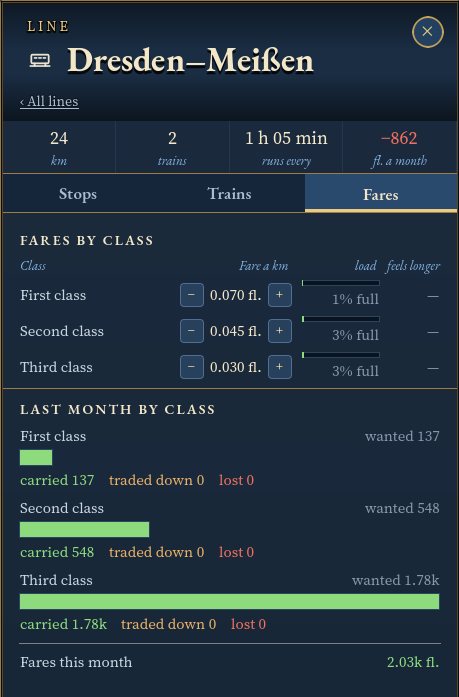 The Fares tab of a passenger line, one row for each class
Every passenger line has a Fares tab in the line builder. Each class gets a row. It has − and + buttons to set the fare a km, a bar showing how full that class ran, and how much longer the trip feels when it is packed. Below that you see last month, class by class: how many people wanted to travel, how many you carried, how many moved down to a cheaper class, and how many you lost.
The usual fares are 0.070 fl. a km for first class, 0.045 for second and 0.030 for third. You can set anything from a quarter of the usual fare up to three times it, in small steps of about 0.008 fl.
Who travels: the gravity rule
For every two towns your lines join, the game works out how many trips people make between them each month:
trips a month = 14.5 × (people of A ÷ 1,000) × (people of B ÷ 1,000)
÷ (1 + felt hours ÷ 2)²
In plain words: two big towns close together swap lots of travellers. A village two days away swaps almost none. We call it the gravity rule because, like planets, big towns pull harder and distance weakens the pull.
Felt hours are how long the trip seems to the traveller, not just how long the train is moving. This is where the quality of your railway shows. They add up:
- the wait for the first train, which is half the time between trains (a waiting hall makes it feel 30% shorter);
- the ride itself, plus 15 minutes at each stop;
- for each change of train, three quarters of an hour, plus the wait for the next train.
So a line with frequent trains wins more passengers, and one through line beats two lines with a change in the middle. Nobody in 1835 enjoyed standing on a cold platform, and neither do our passengers. For each pair of towns, people take whichever journey has the fewest felt hours.
Worked example: Leipzig to Wurzen in November
Leipzig has 46,757 people and Wurzen 3,800. Say you run one Saxonia train between them, 26.5 km, with one first-class, one second-class and two third-class carriages. Here is how the game works out your month:
- The wait: the train makes 4.6 runs a day each way, so passengers wait 1.30 h.
- The ride: 1.05 h, plus the 15-minute stop at the end, 0.25 h.
- Felt hours: 1.30 + 1.05 + 0.25 = 2.60 h.
- The trips: 14.5 × 46.757 × 3.8 ÷ (1 + 2.60 ÷ 2)² = 2,576 ÷ 5.30 = 486 a month. November is an ordinary autumn month, so ×1.0.
- Who sits where: 6% go first class (29), 24% second (117), 70% third (340).
- Commuters: Leipzig is a city (40,000 people or more) and Wurzen is within 30 km, so people come in to work. That is 32 a month, paying 60% of the third-class fare.
- Seats: the train offers 13,276 third-class seats a month each way, far more than needed. Nobody is turned away.
- The fares: 29 × 0.07 × 26.5 + 117 × 0.045 × 26.5 + 340 × 0.03 × 26.5 + commuters 15.5 = 54 + 139 + 271 + 15.5 = about 480 fl.
- The mail: 45 fl. more once Mail contracts is researched (see below); nothing before.
Run the same line in October and you get a different answer. Leipzig's Michaelmas fair opens on 29 September and runs 21 days, 19 of them in October. That multiplies Leipzig's trips by 1 + 0.4 × 19 ÷ 21 = 1.36, so 662 trips instead of 486. Same train, same track, more people with things to buy.
The news explains each part with its reason, for example "Leipzig–Wurzen, third class: 340 passengers at 0.03 fl. a km paid 271 fl."
Fares and classes
Each class reacts to price in its own way. First-class travellers barely notice the fare. Third class counts every coin:
| Class | Share of travellers | Usual fare a km | How much price matters | When full, they try |
|---|---|---|---|---|
| First | 6% | 0.070 fl. | a little (0.7) | second (60% of them) |
| Second | 24% | 0.045 fl. | middling (1.0) | third (80%) |
| Third | 70% | 0.030 fl. | a lot (1.3) | a slower journey, or stay home |
While there are seats to spare, each class has a best fare. For third class on our Leipzig line it is about 0.023 fl.: cheaper tickets, more riders, slightly more money. Once a class is full, though, a higher fare earns more from the same seats. Here is what moving the third-class fare does on that line:
- Raise it to 0.035 fl.: riders drop from 340 to 274, and fares from 271 to 254 fl.
- Lower it to 0.025 fl.: riders rise to 423, and fares to 280 fl.
Crowding
If a class ran more than 85% full last month, the trip feels longer this month: up to 2.5 extra hours in first class, 1.5 in second and 1 in third. So fewer people travel, the train empties a little, and over a few months the numbers settle. We use last month's load on purpose, so a line does not bounce up and down from one month to the next.
People who find their class full move down to the next one and pay its fare. Nobody moves up (first class will not be gate-crashed). If third class is full, those travellers look for another journey that avoids the full stretch. If there is none, they are lost.
Seasons and fairs
People travel less in winter (×0.85) and more in summer (×1.1). The great fairs bring crowds:
| Fair | Opens | Days | Trips there |
|---|---|---|---|
| Leipzig, New Year | 1 January | 21 | ×1.25 |
| Leipzig, Jubilate | three weeks after Easter | 21 | ×1.4 |
| Leipzig, Michaelmas | 29 September | 21 | ×1.4 |
| Frankfurt, spring | three weeks before Easter | 14 | ×1.2 |
| Frankfurt, autumn | 15 August | 14 | ×1.2 |
| Braunschweig, Candlemas and St Lawrence | 2 February, 10 August | 10 | ×1.15 |
The first year your railway reaches a fair town, the game warns you a month ahead, so you have time to add trains.
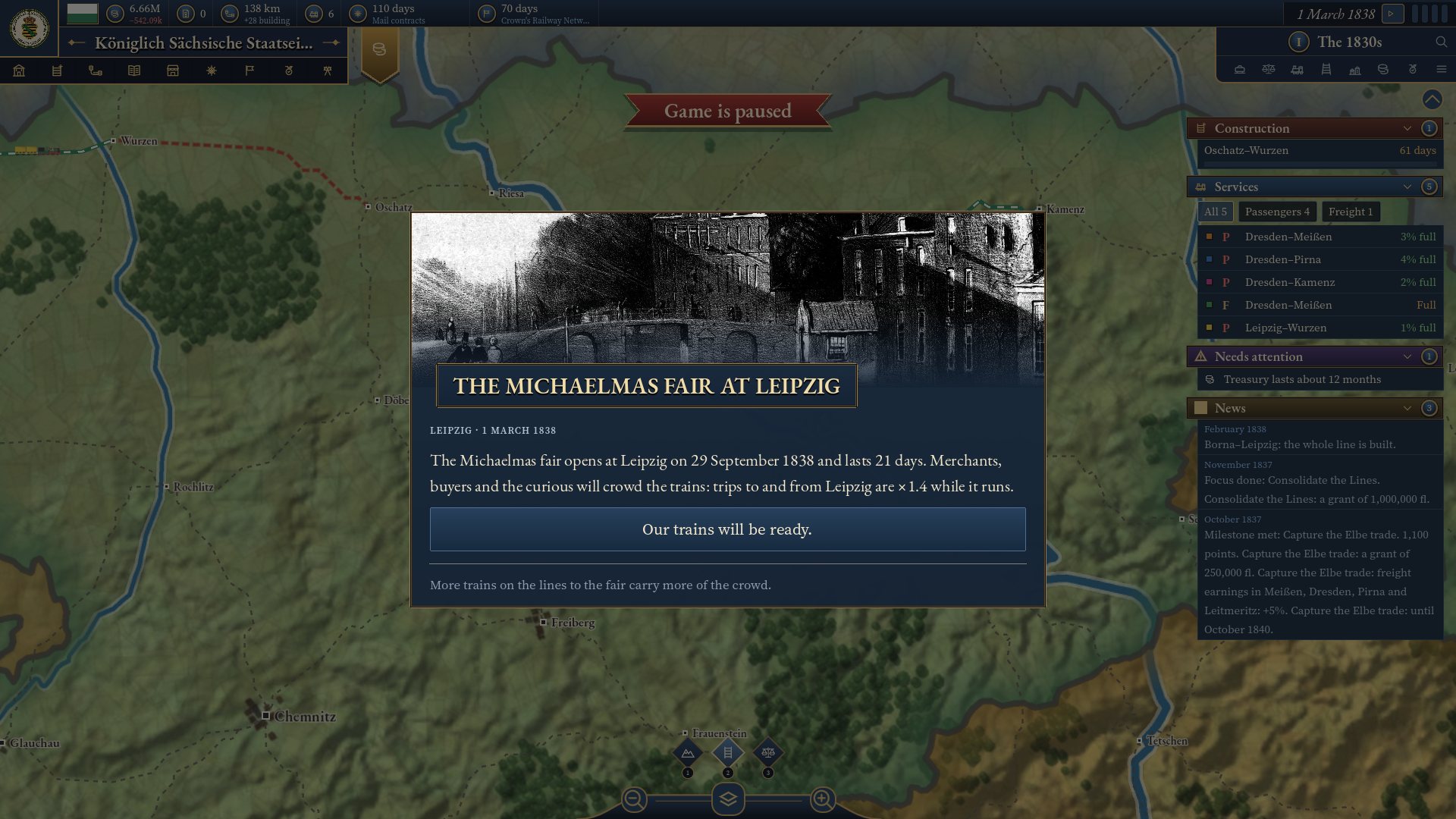 The Michaelmas fair at Leipzig
The fairs are real. Leipzig's Jubilate and Michaelmas fairs go back to the Middle Ages. Frankfurt's autumn fair was held at the Assumption on 15 August. Braunschweig's two fairs had a privilege of 1505. How long each one lasted in the 1830s is still marked "to verify". The multipliers are game values.
Commuters and emigrants
- Commuters travel into a city of 40,000 people or more from towns within 30 km. They ride third class at 60% of its fare, and what they care about most is how often the trains run. Berlin–Potsdam, open along its whole length from 29 October 1838, was the model of the period.
- Emigrants leave the German lands for America through Bremen or Hamburg during the great waves of emigration: 1846–57 and 1864–73, peaking in 1854. Each town of the German Confederation sends a few a month to whichever port its lines reach soonest. They go one way, at the full third-class fare. The number per thousand people is a game value.
The mail
Once you research the technology Mail contracts, any passenger line that calls at a town of 10,000 or more carries the mail, and the post pays you every month. The pay is 4 fl. a km, times the people at the line's stops ÷ 100,000 (at most twice), times its speed ÷ 30 km/h.
For Leipzig–Wurzen that is 4 × 26.5 × 0.506 × 0.84 = 45 fl. a month. Until you research it, the post pays nothing. Mail contracts II and III raise the pay to 1.5 and 2 times that sum, and a post office adds 15% or 30%.
The model is Britain's Railways (Conveyance of Mails) Act of 1838. Prussia's law of the same year is still to verify.
Events
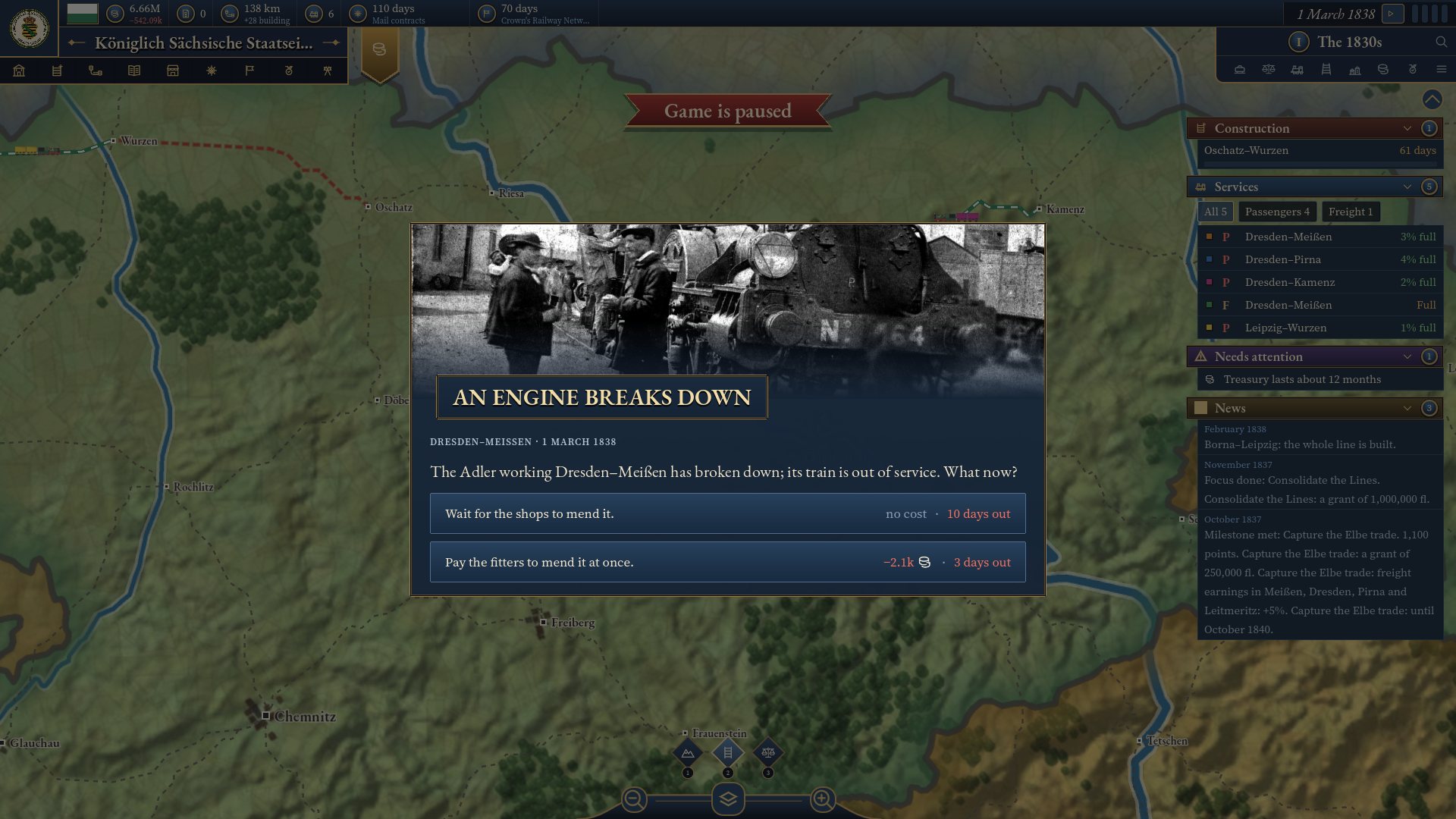 An engine breaks down
The game's random number (seeded, so the same game plays out the same way) decides only whether something happens and where. What happens next is fixed:
- Praise for a line that is reliable and not crowded: trips ×1.1 for six months.
- Complaints in the papers about an overcrowded line. You can let them go (×0.9 for six months) or apologise with cheaper fares for a month (×0.95).
- A festival in a big town: trips there ×1.3 the next month.
- A breakdown.
Why it works this way
Before version 1.5, once a line was running, its numbers hardly moved. Classes, fares, crowding, events and the calendar now make them move, and each move comes with a reason. Fares, classes and crowding are one system on purpose. And the gravity rule with felt hours is what turns "run more trains" from an obvious click into a real decision.
What is still open
- Fares were cut 30% in the latest balance pass, and we are still working through what lines earn.
- Third class. Does cheap third class fill every train too easily?
- Later: stations that grow, towns that draw visitors (spas, universities, royal seats), season tickets, express and stopping trains.
- To verify: the fares of Leipzig–Dresden in 1839, the length of the fairs, and the German mail law.
Sources
- Leipziger Messe: https://de.wikipedia.org/wiki/Leipziger_Messe
- Frankfurter Messe: https://de.wikipedia.org/wiki/Frankfurter_Messe
- Braunschweiger Messe: https://de.wikipedia.org/wiki/Braunschweiger_Messe
- Berlin Potsdamer Bahnhof: https://en.wikipedia.org/wiki/Berlin_Potsdamer_Bahnhof
- Railways (Conveyance of Mails) Act 1838: https://en.wikipedia.org/wiki/Railways_(Conveyance_of_Mails)_Act_1838
- German emigration to America: https://www.loc.gov/classroom-materials/immigration/german/new-surge-of-growth/
Comments None yet
…