22 November 2026
Dev Diary 03 - Lines and Trains
In short
- Track and lines are two different things. First you build track (F2). Then you make lines on it (F3): a passenger or goods service, with its stops in order and its trains.
- You never write a timetable. The number of trains sets how often a line runs, and passengers wait half the time between two trains.
- You buy engines, carriages and wagons in the Shop (F5) and put them together into trains. A train may weigh no more than its engine can pull up the line's steepest climb.
- Trains run on the map as small pictures, one for each line, with their carriages or wagons painted in the line's colour.
In the earliest builds a route was a line. Build Dresden–Meißen, and trains ran on it. That was simple, but it had two problems. One piece of track could not carry both a passenger service and a coal train. And passengers rode anything the track happened to join, whether you meant them to or not. So in version 1.4 we pulled the two apart: track is the rails, a line is the service you run on them.
The Lines window (F3)
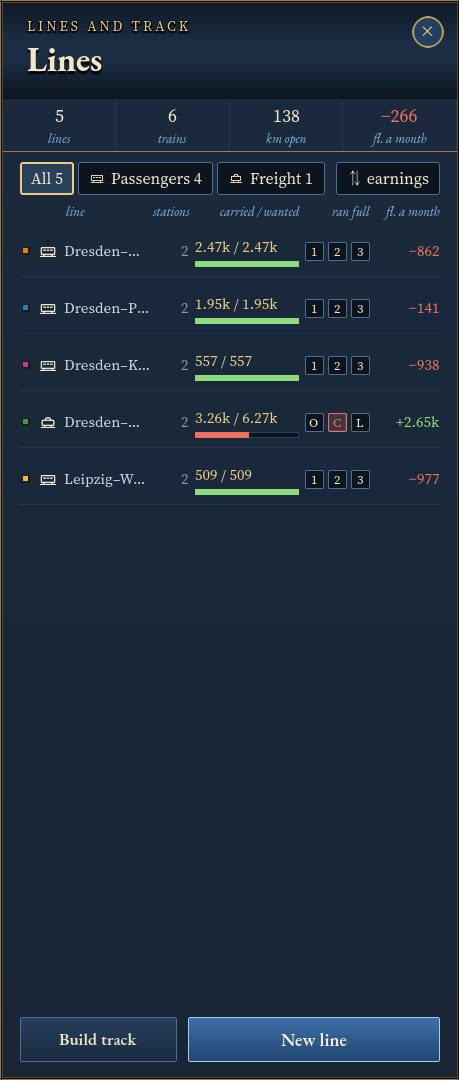 Lines: four passenger lines and a goods line, March 1838
At the top are your totals: lines, trains, km open, and what your lines should make this month after paying for trains and coal. Chips let you filter to Passengers or Freight. Each row is one line, and shows:
- its colour and kind;
- Carried / wanted. Say 1,700 people rode last month and 1,900 wanted to. The 200 left on the platform found no seat, so add a train or more carriages;
- Ran full badges: 1 2 3 for the three classes of carriage, and O C L for open, covered and cattle wagons. A badge turns red when that part ran full;
- its money a month.
Point at a row and the line lights up on the map. Click it to open the line builder.
The line builder
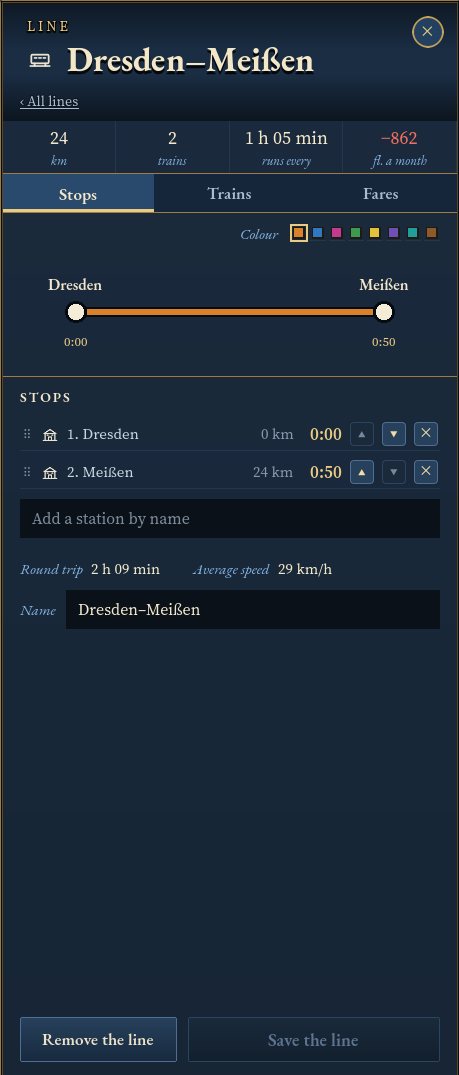 The line builder, Stops tab
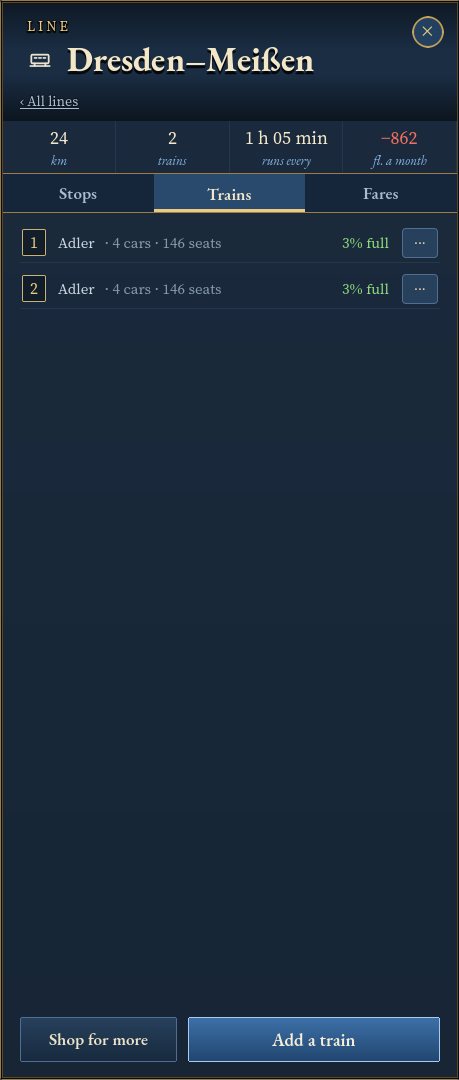 The line builder, Trains tab
At the top of the builder is a link, ‹ All lines, that takes you back to the list, and a small icon for its kind: passengers or goods. A line keeps its kind for good. The builder has three tabs:
- Stops. Click stations on the map in order, or add one by name. Only towns on your open track can be stations. Drag them to change the order. The figures below show the length, the round trip, how often trains run, the room each way and the average speed. Under Expected each month you see the fares, the upkeep and crew, the coal, and the money left over.
- Trains. One row per train: its engine, its cars, and how full it runs. Add a train starts with a copy of train 1, and you can then change the engine or add and take off cars.
- Fares (passenger lines) or Rates (goods lines): what you charge.
How often a line runs
All of these are game values:
- Trains run 12 hours a day, and stop 15 minutes at each station.
- A train runs at its engine's top speed or the line's speed, whichever is slower. The line speed is 30 km/h on iron rails, slowed by the ground and the climb.
- One train makes (12 hours ÷ its round trip) trips a day. More trains, or a shorter line, mean more departures.
- A passenger waits, on average, half the time between two trains. That wait counts towards how long the journey feels. So a line that runs often wins more passengers, even if the trains are no faster.
- A line may run at most 6 trains at first. Technologies raise the limit.
We chose not to make you write timetables. Your levers are trains and carriages, not minutes. (If you love timetables, we are sorry. If you love them very much, we are a little worried.)
Weight against pull
Each engine has two key figures: how many tonnes it can pull on the flat, and the steepest climb it can manage. Uphill it pulls less: 30% less for each percent of grade. So the land matters twice: once in what the track cost to build, and again in what a train can haul up it.
Worked example: one Saxonia from Leipzig to Wurzen
Leipzig–Wurzen is 26.5 km of plain, and its steepest grade is 1.0%. On it runs the Saxonia (pulls 90 t, climbs up to 1.4%, 28 km/h), with one first-class, one second-class and two third-class carriages.
- First, the weight. First class is 6.0 t empty, plus 18 seats × 75 kg = 7.35 t. Second class is 7.90 t. Third class is 8.60 t, and there are two. Loaded, the train weighs 32.45 t.
- Then the pull on a 1% climb. 90 ÷ (1 + 0.3 × 1.0) = 69.2 t. So the train can run, with room to spare: it could take four more third-class carriages. A fifth would be refused, and the game tells you why: "The Saxonia pulls 69.2 t up this line's 1.0% grade; the train weighs 75.45 t."
- The speed. The line allows 30 × (1 − 0.1 × 1.0) = 27 km/h. The Saxonia only makes 28 on the flat anyway, so the 26.5 km take 1 h 3 min.
- The round trip is 2 × 1 h 3 min + 2 stops × 15 min = 2 h 36 min. That is 4.6 runs a day each way. Passengers wait 1.3 hours on average.
- The room is 146 seats × 4.6 runs × 30 days = 20,190 seats a month each way.
- The costs a month:
- Upkeep and crew: Saxonia 150 + carriages 30 + 20 + 2 × 14 + crew 600 = 828 fl.
- Coal: 7,330 km × 0.013 t × 1.2 (extra for the climb) = 114 t. The nearest pits are at Borna, 28 km away by road, so a tonne costs about 9.70 fl. at Leipzig, against 40 fl. for coal brought from far away. That makes about 1,108 fl.
- In all: about 1,936 fl. a month, before the track's own upkeep.
- And the income. In a November this line takes about 480 fl. in fares, plus 45 fl. for the mail once you have researched Mail contracts.
So a short line to a small town with one slow train does not pay. The Lines window picture above shows the same thing: both Leipzig–Wurzen lines lose money. What helps? A longer line to a big town (the real Leipzig–Dresden was about 116 km), a mine on the line for cheap coal, a coaling stage, and the technologies that cut running costs. That is the first lesson of the game, and we think it is a fair one. The Saxonia agrees, though it would never say so.
The Shop (F5)
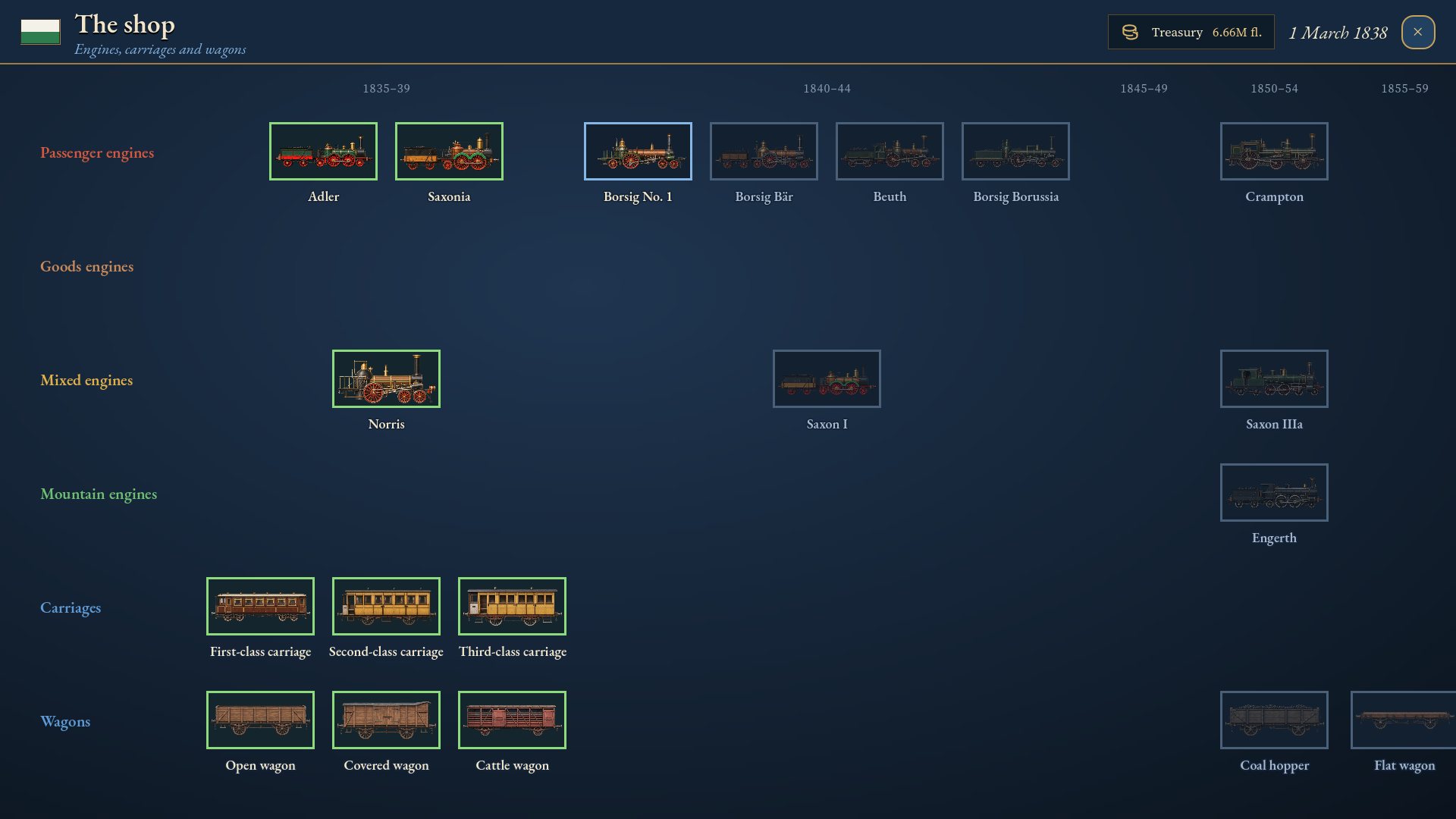 The shop: engines, carriages and wagons on a timeline
The Shop is laid out as a timeline. There is a column for every five years, and a row each for passenger, goods, mixed and mountain engines, carriages and wagons. The frame of each tile tells you where you stand with it:
- green: you have some in the depot;
- blue: you can buy it;
- gold: it is being researched;
- slate: it is waiting for a technology.
Click a tile for its card: speed, pull, steepest climb, coal per 100 km, seats or load, weight, upkeep, price, and what it sells for.
- Every train after 1835 is first unlocked by a technology, then researched in its own days (120 for an engine, 60 for a carriage or wagon), and only then bought.
- An engine built at home costs 85% of its price. The Saxon railway pays 15,300 fl. for a Saxonia, not 18,000.
- A train you sell brings back 60% of its list price.
- What you buy waits in the depot until it joins a train.
Some of the Shop's engines, with their game figures:
| Engine | Year | km/h | Pull | Climbs | Price |
|---|---|---|---|---|---|
| Adler | 1835 | 30 | 80 t | 1.4% | 21,000 fl. |
| Saxonia | 1838 | 28 | 90 t | 1.4% | 18,000 fl. |
| Norris | 1838 | 32 | 110 t | 1.8% | 24,000 fl. |
| Beuth | 1844 | 45 | 140 t | 1.8% | 30,000 fl. |
| Crampton | 1853 | 60 | 120 t | 1.2% | 38,000 fl. |
| Engerth | 1854 | 25 | 280 t | 2.8% | 52,000 fl. |
There are 21 engines in all, up to 1888. The figures are game values, but the engines themselves are real, and so is the outline of their story:
- The Adler ran Nürnberg–Fürth from 7 December 1835.
- The Saxonia was the first engine built in Germany, by Johann Andreas Schubert at Übigau near Dresden in 1838.
- The American Norris engines were known for climbing.
- The Beuth came from Borsig of Berlin in 1844.
- The Crampton was fast on the flat but a poor climber.
- The Engerth was built for the Semmering after the trials of 1851.
The Shop's pictures were drawn for the game.
Trains on the map
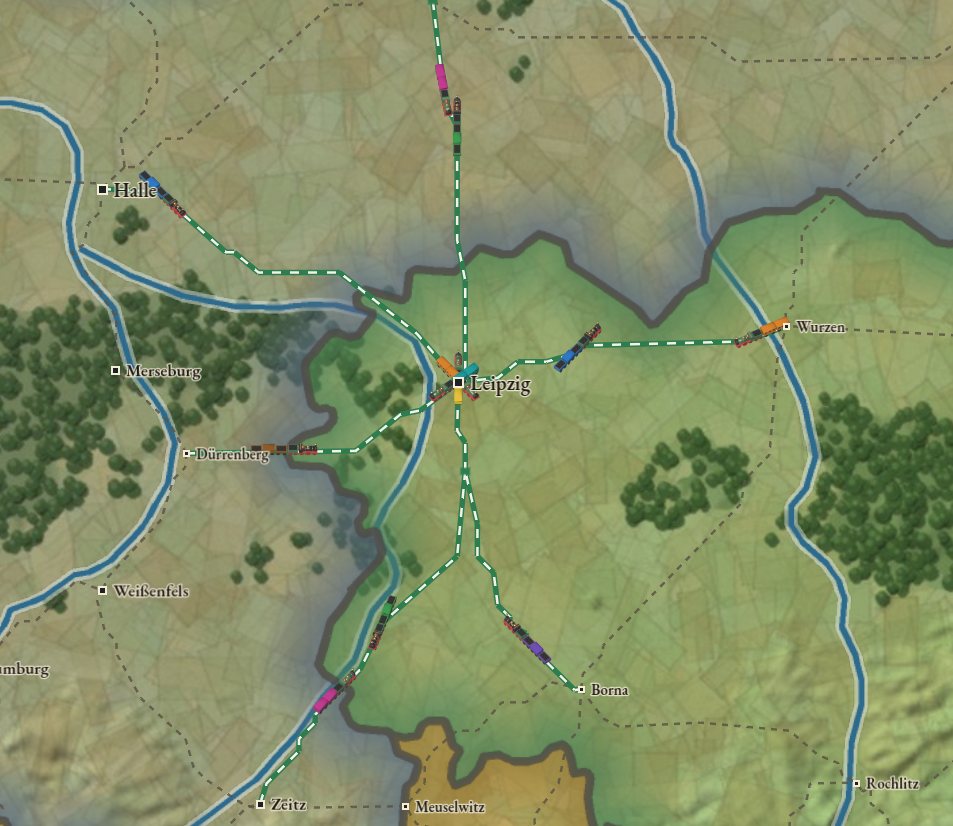 Trains round Leipzig, each line's train in its colour
Zoom in on the Rail map and the trains appear: small pictures, drawn facing 32 different directions, half size when you are far out and full size close in. Each line's carriages or wagons are painted in the line's colour, so you can tell your lines apart at a glance.
The map shows one train per line. Early tests drew every single train, and the map turned into a swarm of bees with funnels (4,800 trains took 15 ms a frame to draw). One per line is easier to read and cheap to draw. Lines that share track are drawn apart: each line's train runs a fixed fraction of the way ahead of the next, so two lines on Leipzig–Wurzen never sit on top of each other.
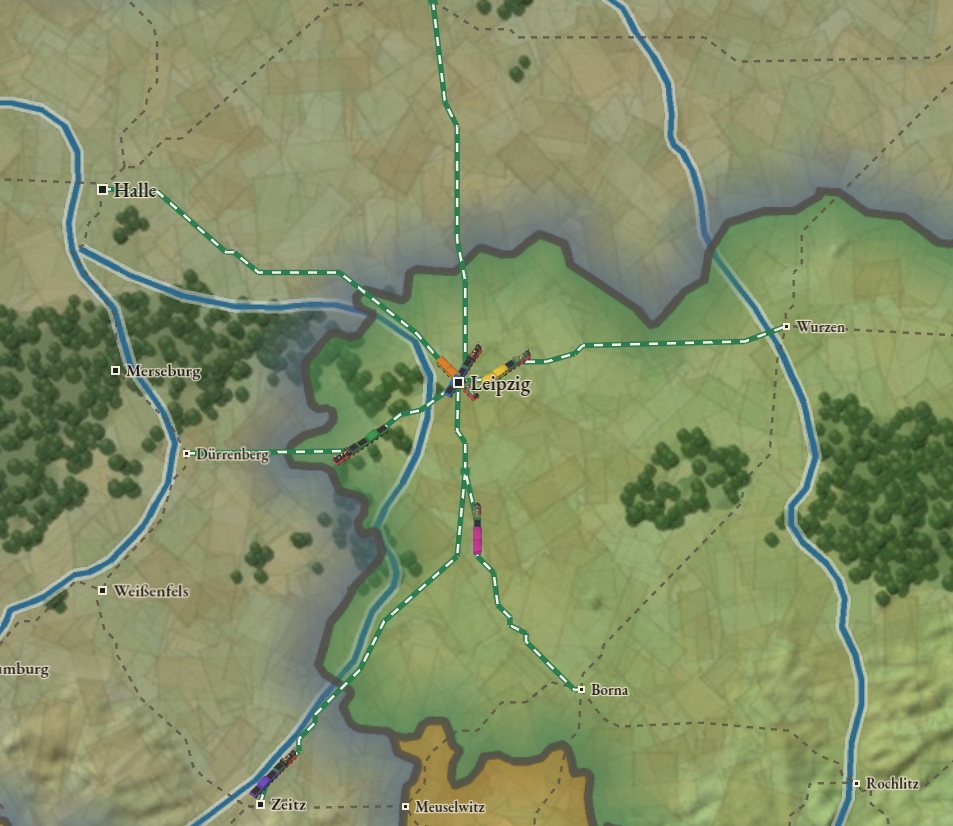 One train alone on each route
Breakdowns
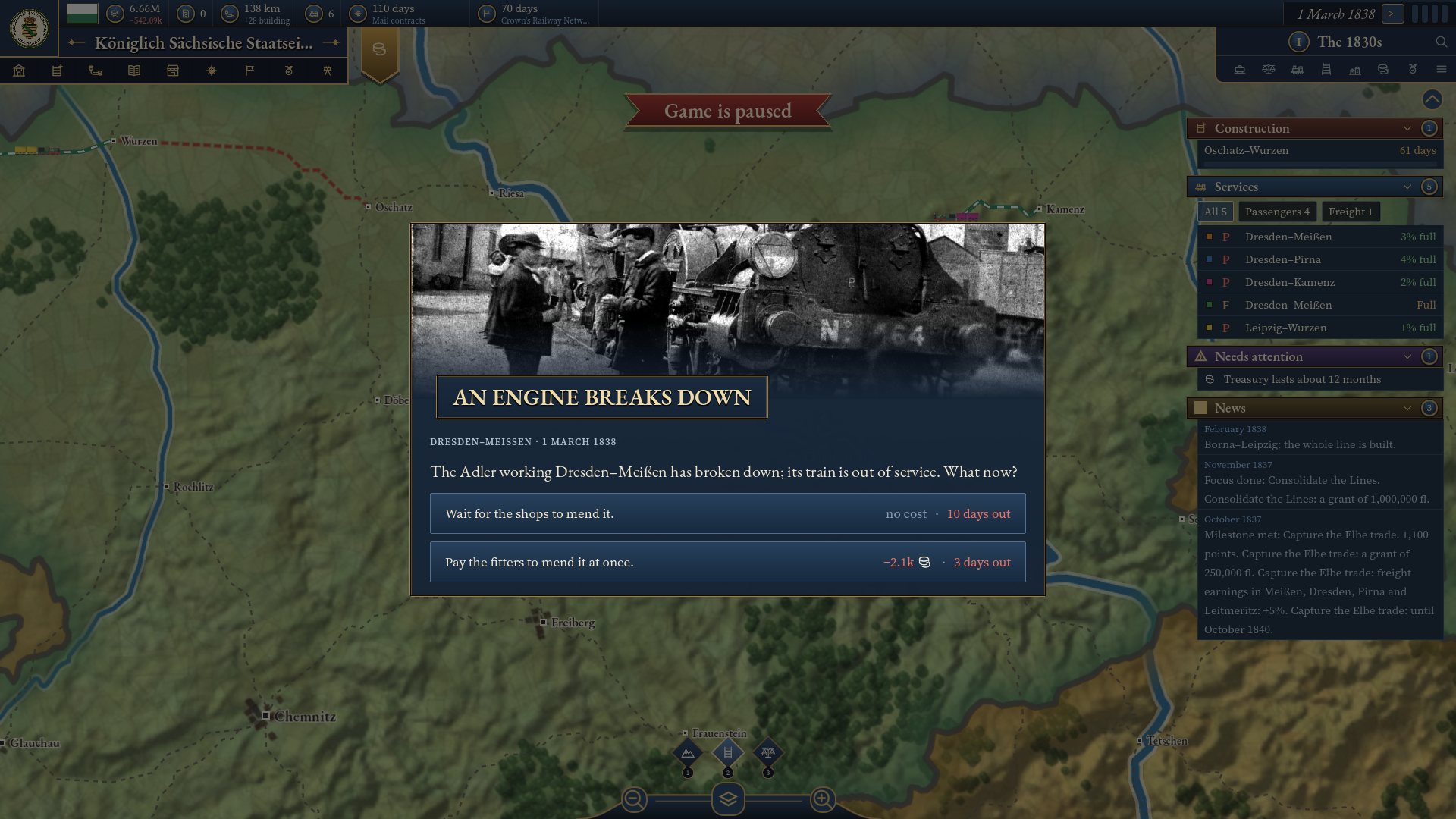 An engine breaks down
Engines fail now and then, and older ones more often. The chance is 2 in 1,000 a month, plus a tenth more for each year the engine has been on the line. A seeded random roll picks which train fails, and that is all chance decides. Your answers are fixed:
- Wait for the shops: 10 days out of service, at no cost.
- Pay the fitters: 10% of the engine's price, 3 days out.
A train that broke down cannot fail again for six months. An engine depot and a workshop make it cheaper.
What is still open
- Balance. Earnings are still being tuned: lower fares, higher freight rates, longer goods trains, and so on.
- The stage coach. Should passengers have an old way to travel, the stage coach, that a slow line has to beat?
- Hovering over a train on the map to see its line, engine and load.
Sources
- Adler: https://en.wikipedia.org/wiki/Adler_(locomotive)
- Saxonia: https://de.wikipedia.org/wiki/Saxonia_(Lokomotive)
- William Norris: https://en.wikipedia.org/wiki/William_Norris_(locomotive_builder)
- Beuth: https://de.wikipedia.org/wiki/Beuth_(Lokomotive)
- Crampton locomotive: https://en.wikipedia.org/wiki/Crampton_locomotive
- Engerth locomotive: https://en.wikipedia.org/wiki/Engerth_locomotive
Comments None yet
…