20 November 2026
Dev Diary 02 - Building Track
In short
- You never draw track by hand. You pick two towns, and your surveyors offer one or more ways between them. These were found in advance from real heights, rivers and forests.
- Each way has a length, a cost, a building time and a steepest climb. Hills cost twice as much as flat land, a pass five times as much, and a tunnel eight times.
- All the parts of a line are built at the same time. Each part opens the day it is done. You pay as the work goes on, in even monthly amounts.
- Some ways must wait: passes for engines that can climb, long tunnels for the know-how to dig them, and other states' land for an agreement.
Our first question was simple: how should you lay track on a real map of Europe? Drawing it square by square would be slow. Worse, it would let you run a line straight up a mountain. Railway engineers of the 1830s did not do that either. They followed valleys and rivers and climbed as gently as they could. So we let the map find the routes, and you choose between them.
The Build track window (F2)
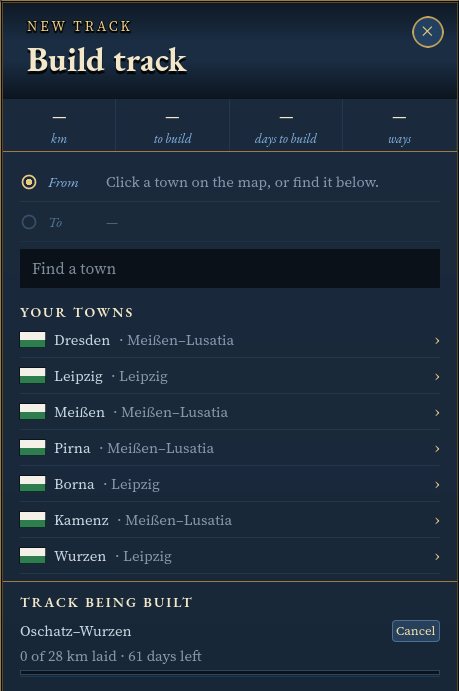 Build track, with the track being built at the bottom
Building takes three steps: 1 · From, 2 · To, 3 · Route. Click a town on the map, or type its name in the Find a town field. If you have not searched for anything, the window lists Your towns, and then the towns that can be joined to the one you picked.
Then the surveyors report back. You get one or more different routes, each with its length, its cost and its days to build. The way you choose lights up on the map, with a height profile underneath that shows where it climbs.
At the bottom of the window is the track being built: each job, how many km are laid and how many days are left. Point at a row and that job lights up on the map.
The line window
Before you spend a single florin, the line window shows you everything about a way. Here is a line from Dresden to Kamenz, ready to build. Its Costs tab splits up the bill and shows the height along the line:
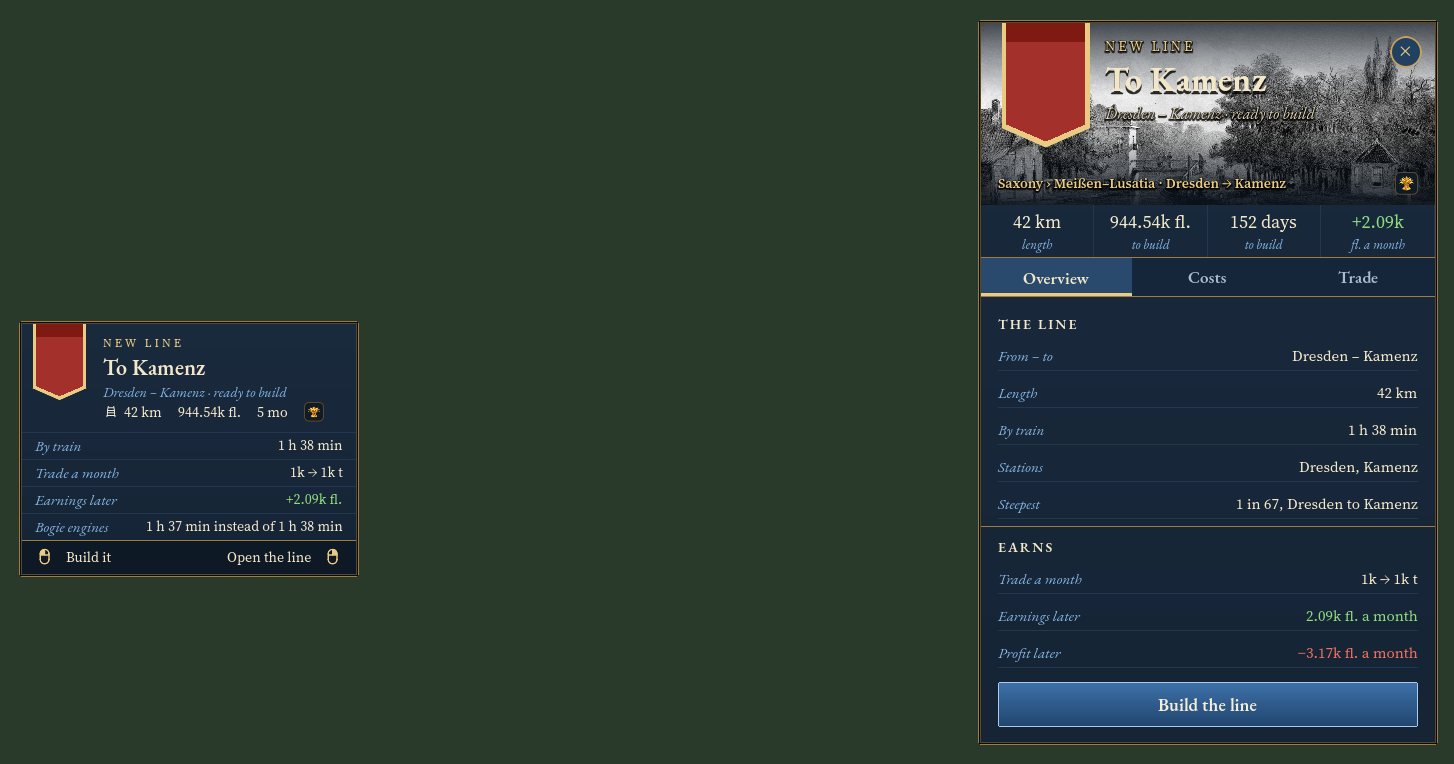 The line window: a new line to Kamenz
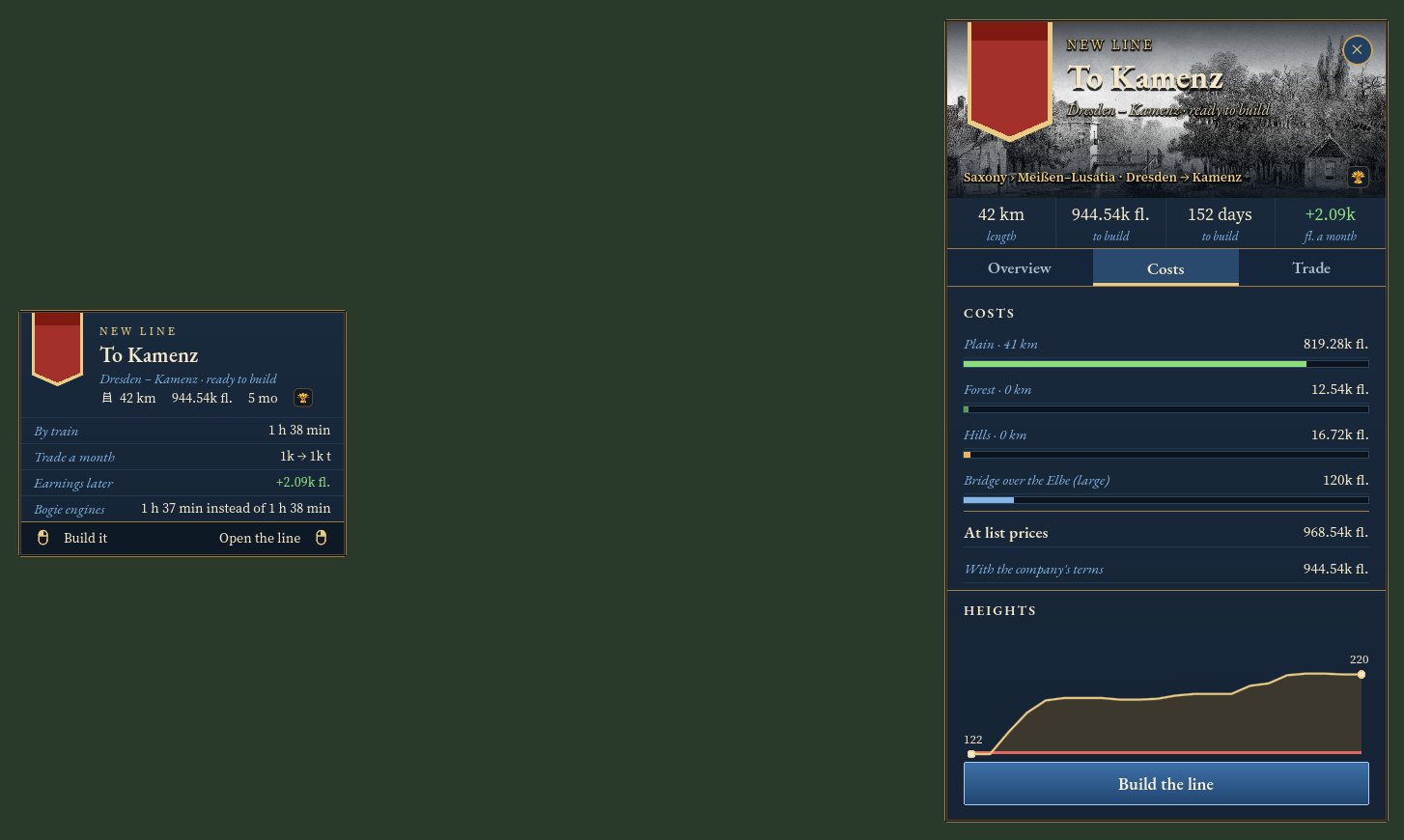 Its costs and height profile
Routes are worked out in advance
The ways are made before the game ships, by the same tools that bake the map. Here is how:
- Sorting the ground. The tools sort every cell of the map into a kind of ground: plain, forest, hills, mountain valley or pass.
- Finding the path. Then they find the cheapest path between every pair of neighbouring towns. The search counts 100 m of climb as costly as 5 km of flat track, so lines keep to the valley floors, as real ones did.
- Stations, tunnels, bridges. A town within 2 km of the path becomes a station. A steep stretch of a km or more becomes a tunnel. Where the path crosses a river, the bridge is sized by the river: the Donau, Rhein and Elbe need large bridges, the Isar, Main and Saale medium ones.
Each piece of way between two neighbouring towns is called a section. In the data today there are 4,160 sections joined at 867 junctions, offered as 3,297 route options. That is about 116,800 km of possible railway, which should keep you busy for a while.
In the game, the route search only walks along this network of ready-made sections, like a road planner. It looks for the fastest way and the cheapest way. If two are equally good, it picks by the sections' ids, so the same question always gets the same answer. It never looks at the terrain itself. That keeps the game fast and the answers repeatable.
Track you already own costs nothing to reuse. Say a second line leaves Dresden along your first one: it pays only for the new part, from the point where it branches off.
What a km costs
All of these are game values. A km of flat track (plain) costs 20,000 fl. Other ground multiplies that cost, and slows the trains:
| Ground | Cost × | Speed × |
|---|---|---|
| Plain | 1.0 | 1.0 |
| Forest | 1.5 | 1.0 |
| Hills | 2.0 | 0.9 |
| Mountain valley | 3.0 | 0.75 |
| Pass | 5.0 | 0.5 |
| Tunnel | 8.0 | 1.0 |
So a km through hills costs 40,000 fl., and a km of tunnel 160,000 fl.
Bridges are paid once each: 40,000 fl. for a small one, 80,000 for a medium one and 120,000 for a large one. Trains run at 30 km/h on iron rails. The ground slows them, and so does the climb: 10% slower for each percent of grade.
A line takes months to build. Workers lay 10 km of open track a month, and hard ground and bridges count as extra km. Tunnels go at only 0.2 km a month. Bring a book.
Worked example: Leipzig to Dresden
The real Leipzig–Dresden line opened all the way on 7 April 1839, by way of Wurzen, Oschatz and Riesa. In the game, the baked way follows the Elbe valley on to Meißen:
| Section | km | Ground | Bridge | Cost | Months |
|---|---|---|---|---|---|
| Leipzig – Wurzen | 26.5 | plain | small, over the Mulde | 26.5 × 20,000 + 40,000 = 570,000 | 3 |
| Wurzen – Oschatz | 28.4 | plain | — | 568,000 | 3 |
| Oschatz – Riesa | 13.4 | plain | — | 268,000 | 2 |
| Riesa – Meißen | 21.9 | plain | large, over the Elbe | 438,000 + 120,000 = 558,000 | 3 |
| Meißen – Dresden | 23.7 | plain, some hills and forest | — | 545,100 | 3 |
| Whole line | 113.9 | 2,509,100 fl. | 3 |
- Time. All five sections are built at the same time, so the line takes as long as its slowest section: 3 months, shown as about 91 days. Oschatz–Riesa is shorter, so it opens a month early.
- Paying. Each section is paid in even parts over its months. Month 1 costs 190,000 + 189,333 + 134,000 + 186,000 + 181,700 = 881,033 fl. You need that sum in the treasury before work begins. Month 3 costs less (747,033), because Oschatz–Riesa is already paid off.
- Running. A train takes about 4 hours 9 minutes for the whole way, about 27 km/h on average.
- Upkeep. Once open, the line costs about 9,214 fl. a month to keep up: 7,914 for the track and 1,300 for the six stations.
Started a line by mistake? It happens to the best of us. For its first 30 days, and as long as no part of it is open, the Build track window offers Cancel: the work stops and you get back everything paid so far.
This line is quick to build because the Elbe valley is flat. A mountain line is another story.
Passes and tunnels
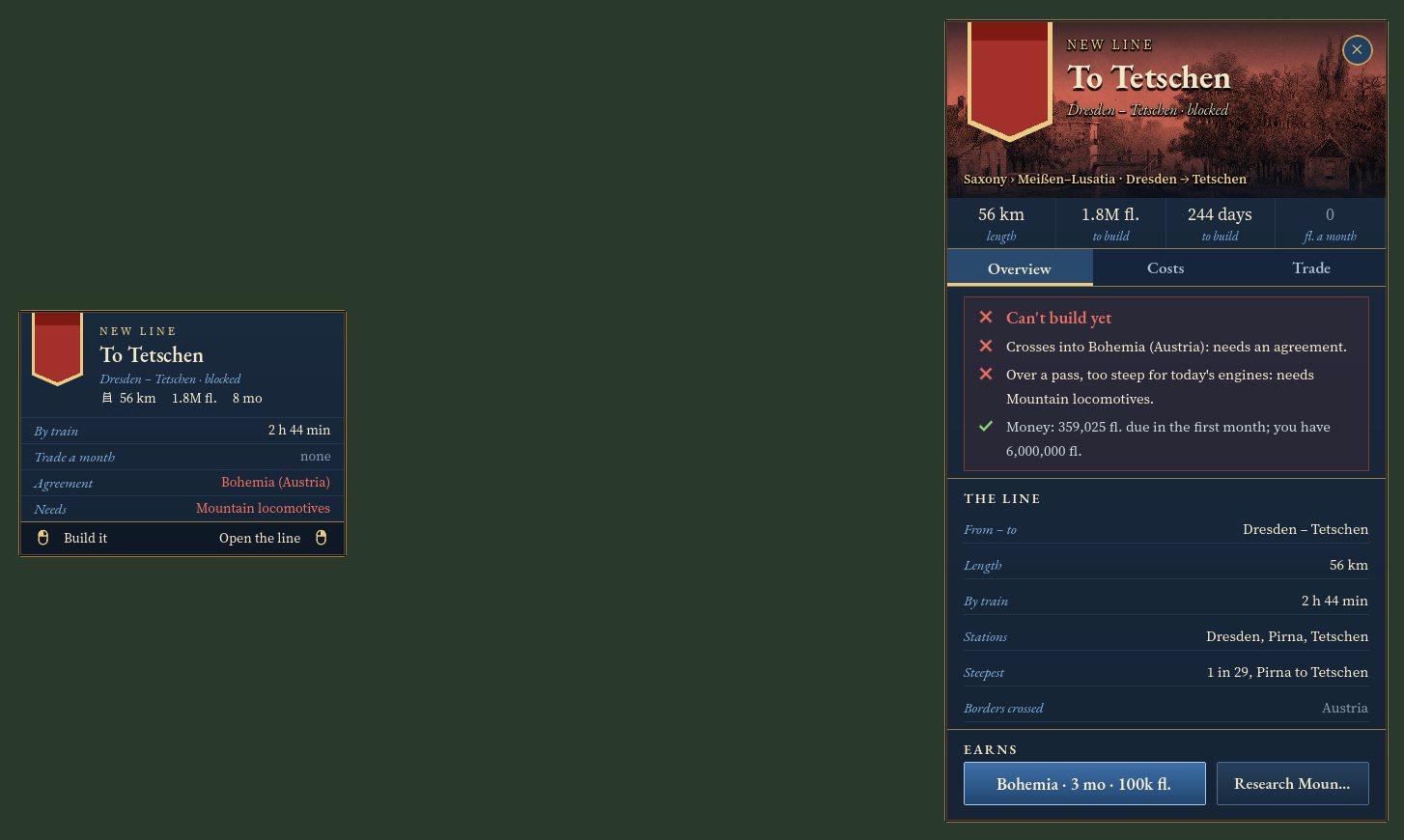 A way that cannot be built yet: Dresden to Tetschen over the hills of the Elbe, across the border into Bohemia
Point at a way on the map and its card tells you straight away what stands in the way:
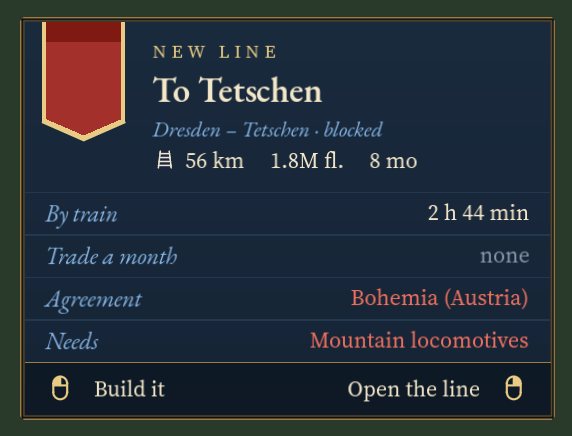 The card of the way to Tetschen: it needs an agreement and Mountain locomotives
Engines of 1835 could not climb much. You cannot build a way steeper than 1 in 40 (2.5%), that is 2.5 m up for every 100 m along, until you have the technology Mountain locomotives (from 1851). A tunnel of 3 km or more needs Tunnelling (1858). You can see these ways on the map from the first day, but they have to wait. The line window says why, and offers a button to fix it: Research Mountain locomotives.
The Semmering is the classic case. The real Semmering railway opened in 1854. In the game, Over the Semmering is a single section from Gloggnitz to Mürzzuschlag: 24.3 km, climbing from 506 m to 876 m, steepest 1 in 12. It costs 1,657,260 fl. and 9 months, and a train needs almost seven hours to crawl over it. And under the Gotthard, the tunnel section alone takes 80 months.
Better track
New track is always iron. Later technologies let you relay it as steel (Steel rails, 1862), and then as heavy steel (1870). You relay from the Lines window, 40 km a month, and trains keep running while you do:
| Track | Speed × | Upkeep × | To relay |
|---|---|---|---|
| Iron | 1.0 | 1.0 | — |
| Steel | 1.4 | 1.25 | 15,000 fl. a km |
| Heavy steel | 1.85 | 1.5 | 25,000 fl. a km more |
Faster trains, but dearer to keep up: that is the trade.
Floods, avalanches and landslides
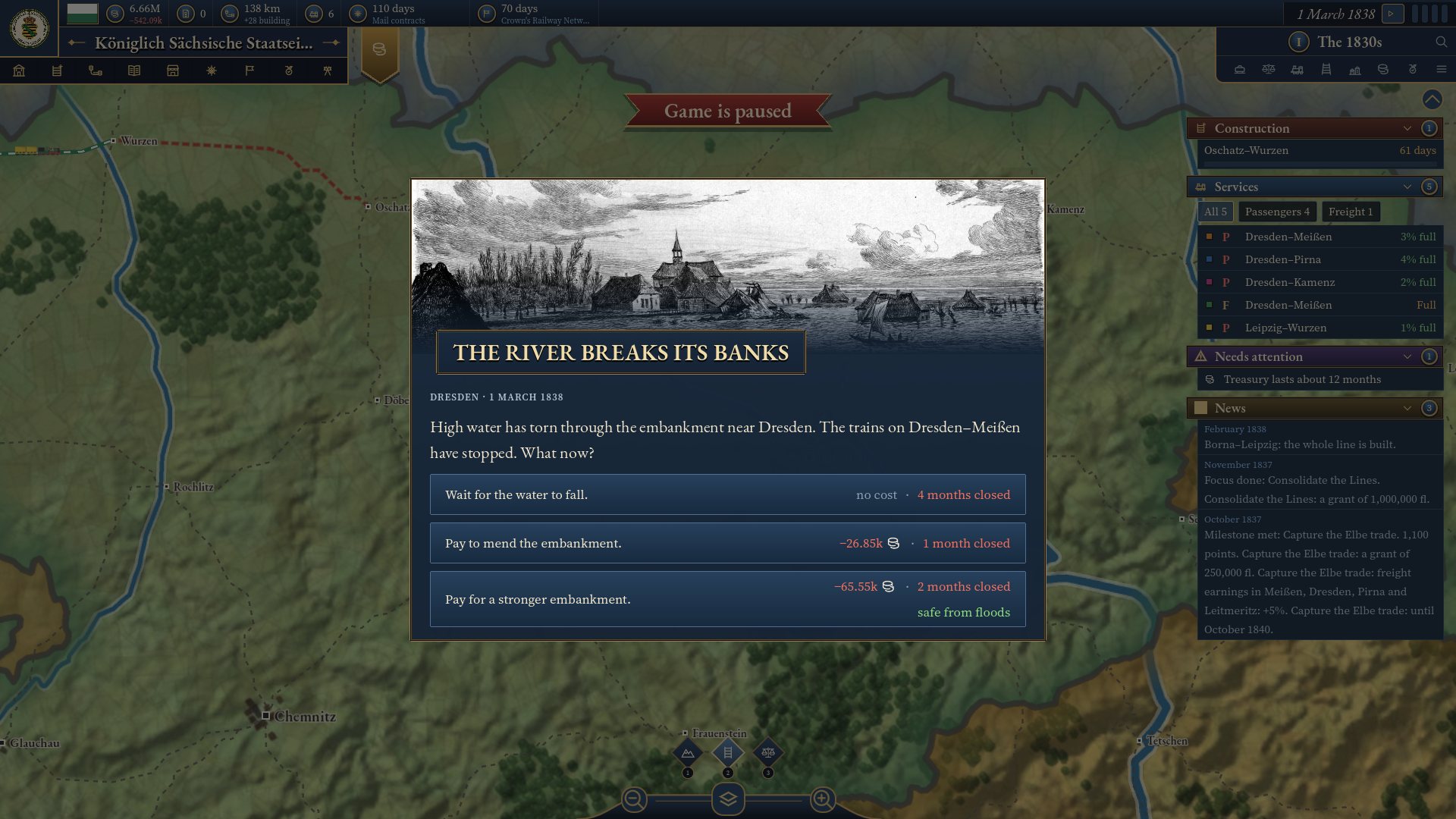 The river breaks its banks
The game rolls dice in only one place here: to pick whether damage strikes, and where. Everything after that is fixed. Floods strike bridges and valley floors, worst from March to May. Avalanches strike passes in winter. Landslides strike steep hills and tunnels. Track still being built, and track in its first three years, is more at risk.
You get three answers, each with its cost and the months the line stays closed:
- Wait: free, but closed for months.
- Repair: you pay a sum, and it is closed about a month.
- Rebuild stronger: dearer, but safer afterwards. A flood never hits that place again.
A line that was hit is then safe for five years, so no company is ruined by bad luck.
Across borders
In 1835 the German lands were some forty states, and a railway needed each one's permission. In the game, a line that enters another state needs an agreement, either for the region it enters or for the whole state:
| Fee | Talks | |
|---|---|---|
| A region of a German Confederation state | 100,000 fl. | 1–3 months, by its people |
| A region of any other state | 250,000 fl. | 1–3 months |
| A whole state | 3–4 times the fee | 6–9 months |
"By its people" means the talks take longer the more people live in the region.
Worked example. Say the Saxon railway wants to run into the Prussian Province of Saxony (1,509,022 people). Both states are in the German Confederation, so the fee is 100,000 fl. The talks take 1 + 2 × ln(15.1) ÷ ln(40) ≈ 2.5 months, rounded to 2. An agreement for all of Prussia would cost about 400,000 fl. and take 9 months.
Don't worry about the formula. All it means is that bigger regions take longer, but not much longer: a state of ten million is never a hundred times slower than one of a hundred thousand.
History did the same, stretch by stretch: the Saxon-Bavarian treaty of 1841 covered the line from Leipzig to Hof.
You may also run your trains on another company's track with a running agreement. It costs 20,000 fl., the owner answers in 2 months, and you pay a toll of 0.3 fl. for every km each train runs. (The toll is the owner's fair share for the use of its track.) The owner refuses only if you already compete with one of its lines between the same two towns.
Why it works this way
- A road planner, not a pencil. You pick towns and choose between real alternatives: the cheap, slow valley or the dear, fast short cut.
- Built side by side (9 November). A long line used to take the sum of its sections' months, while building the same sections one by one was quicker. That made no sense, so now both take the same time.
- No more building materials (10 November). For a while, players bought stone, timber and iron on a small market. It turned the building screen into a spreadsheet, and nobody came to 1835 to do spreadsheets, so it was removed. A section's bill now covers labour, land and materials together.
- Upkeep keeps money tight as your network grows. We cut it by a third in version 1.4, so early lines can pay their way.
What is still open
- More named passes: the Tauern, Lötschberg and Le Perthus are not offered yet.
- Owners setting their own tolls on running agreements.
- Agreements with some bargaining in them, a small return of the treaty game this project grew from.
- All costs, speeds and risks are game values, still to be tuned.
Sources
- Leipzig–Dresden railway: https://en.wikipedia.org/wiki/Leipzig%E2%80%93Dresden_railway
- Leipzig-Dresdner Eisenbahn-Compagnie: https://de.wikipedia.org/wiki/Leipzig-Dresdner_Eisenbahn-Compagnie
- Bavarian Ludwig Railway: https://en.wikipedia.org/wiki/Bavarian_Ludwig_Railway
- Semmering railway: https://en.wikipedia.org/wiki/Semmering_railway
- Sächsisch-Bayerische Eisenbahn: https://de.wikipedia.org/wiki/S%C3%A4chsisch-Bayerische_Eisenbahn
Comments None yet
…